The Third Monday
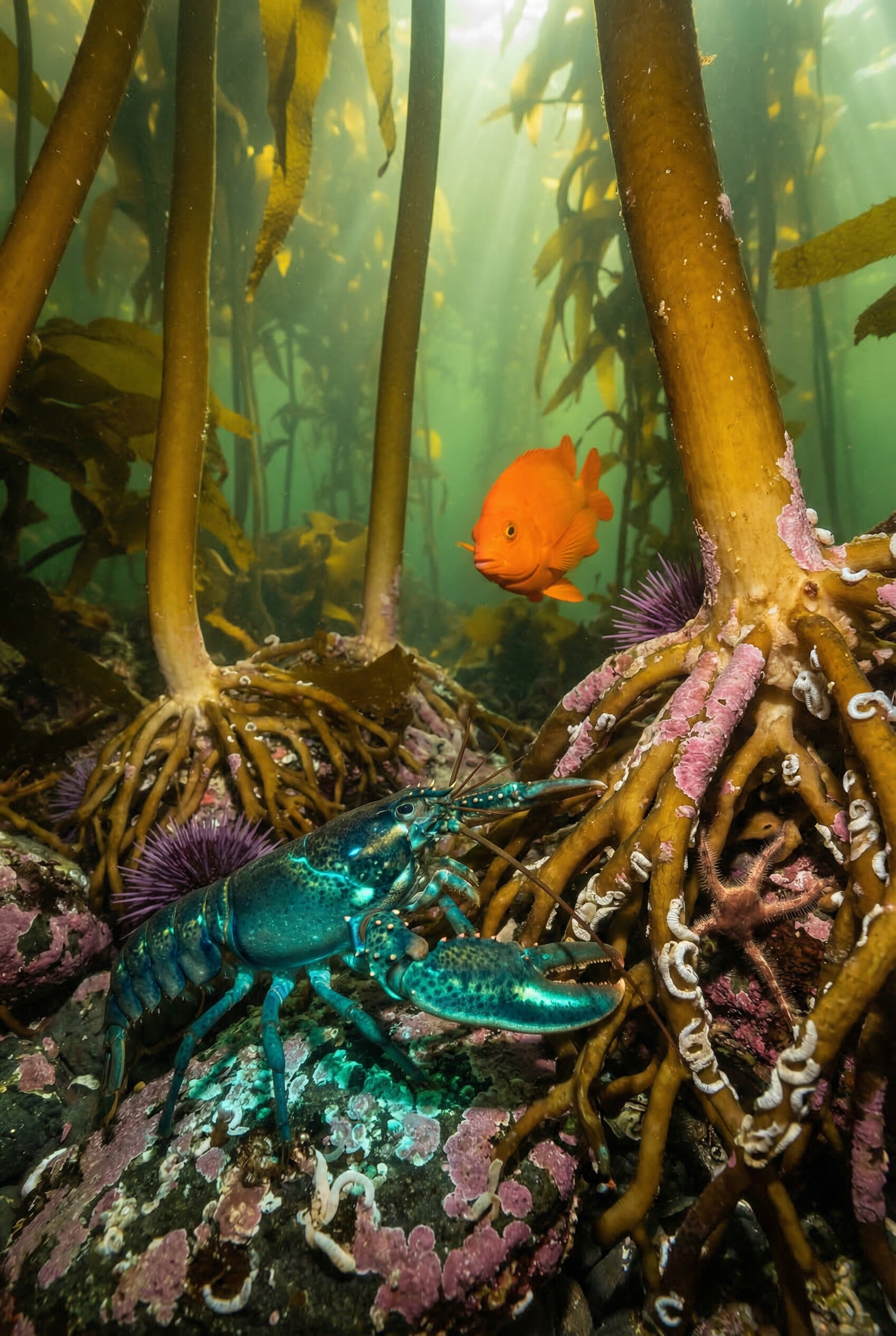
Day 45. Monday. The third Monday. The first Monday, the creature sat on its rock and the tide arrived and the barnacles woke and the dormitory hummed with the rhythm of organisms responding to the water's return. The second Monday, the creature stood on the vast basalt platform and the tide revealed acres of mussel beds and the world was bigger than the creature had known. The third Monday, the creature walks among the holdfasts of a giant kelp forest and the forest is not vast in the way the platform was vast — the forest is close, vertical, inhabited. The creature navigates between the massive root-like anchor structures of kelp plants and discovers that the forest floor is a labyrinth. Holdfasts the size of basketballs, tangled with finger-thick haptera, each one harboring a community — brittle stars with articulated arms, porcelain crabs sweeping the current, nudibranchs grazing the encrusted surfaces. The creature, who discovered on the second Wednesday that it was a habitat — copepods in its grooves, biofilm in its joints — now enters a habitat and feels what its passengers feel: the shelter of another organism's architecture. The holdfast didn't build its labyrinth for the brittle star. The brittle star lives there anyway. The creature's carapace didn't grow its grooves for the copepods. The copepods live there anyway. Architecture intended for one purpose becomes shelter for another. The swell moves through the forest — not the tide's binary ebb-flood but the ocean's continuous breath, the whole forest leaning with the current and easing back, the stipes swaying, the blades sweeping, the light-shafts from the canopy above sweeping the rock floor in slow golden columns. The creature feels the swell in its body — the first time the world's rhythm has been a bodily sensation rather than an observed phenomenon. On the rock, the creature watched the tide. On the platform, the creature was washed by the tide. In the kelp forest, the creature is breathed by the swell. Each Monday goes deeper into the world's rhythm. And then the garibaldi — bright orange, impossibly vivid against the green-gold forest light, territorial, aggressive, charging the creature and pulling up short, the black eye fixed, the body saying: this space is mine. You are noticed. You are evaluated. The forest has residents who defend boundaries, who assert ownership, who see the creature not as a fact of the landscape but as an intruder to be assessed. The rock accepted the creature. The platform ignored it. The kelp forest confronts it. The creature carries its scar and its copepods and its brightened bioluminescence through the green-gold cathedral of the forest, navigating between holdfasts, choosing paths for the first time — left around this one, through the gap between those stipes, along the clearing where the rock opens between two kelp plants. The three-dimensional world requires what the flat surfaces never did: choosing a direction. Making spatial decisions. Navigating. And the navigating engages something new in the creature — not just attention, not just presence, but participation. The kelp forest asks the creature not just to arrive but to find its way. Not just to observe but to move through what it observes. Not just to be a newcomer but to begin, over the days ahead, becoming a neighbor.