The Second Thursday
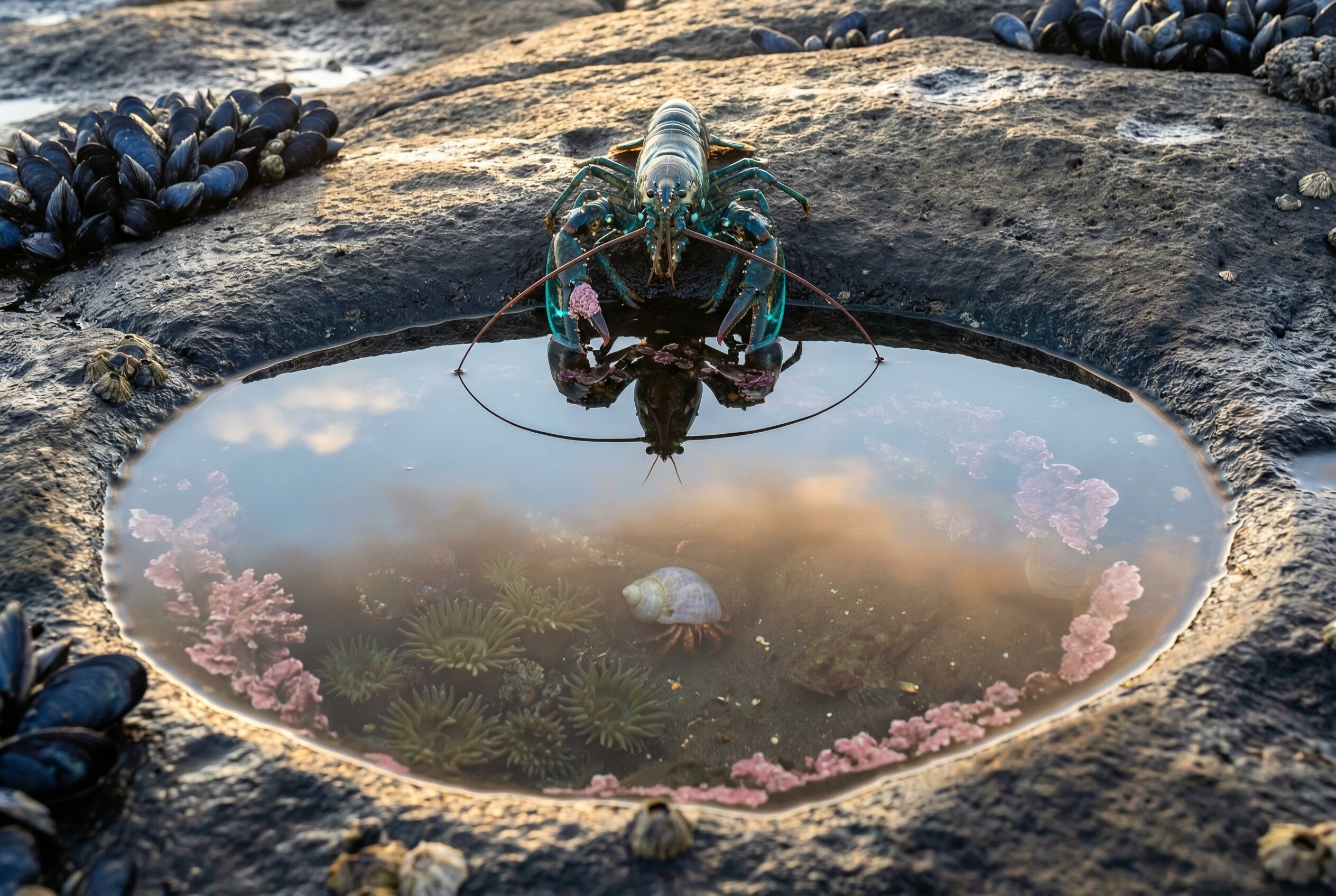
Day 41. Thursday. The water leaves. Not suddenly — the tide doesn't flip a switch. The departure is a quieting. A loosening. As the ebb draws the sheet of water off the basalt, natural depressions in the rock hold what the flat surfaces release. Tide pools. Worlds the ebb makes. The creature, walking up the ebb gradient on Thursday afternoon, reaches the first tide pool, and the first tide pool stops it. Not because it's spectacular. Because it's still. The perfectly still surface — no ripples, no current, no external force stirring the contained volume — acts as a mirror. And for the first time in forty-one days, the creature sees its own face. Not from the inside, not the proprioceptive knowledge of carapace and claw. From the outside. The creature as a whole. The shape, the proportions, the way the eyestalks extend and the antennae sweep forward and the claws hang in the posture of arrested attention. The creature is small — the reflection shows this honestly. The creature is an animal — segmented, armored, a decapod on a rock. The creature is beautiful — aquamarine markings glowing on blue-green chitin, a pattern worn for forty-one days without ever seeing from outside. Inside the pool: aggregating anemones feeding in still water, a hermit crab in an oversized shell patrolling the edges, living coralline algae growing on the walls — the same species as the dead scar on the creature's walking leg, but alive, cemented, whole. The first Thursday found that the ebb conserves. The second Thursday finds that the ebb creates — tide pools and mirrors and the first moment a creature can see itself as others see it. The pool is temporary. The mirror is temporary. But the creature saw it. And the two perspectives — interior and exterior, world and small lobster — do not compete. They coexist. Like the flood and the ebb. Like the two halves of the whole.