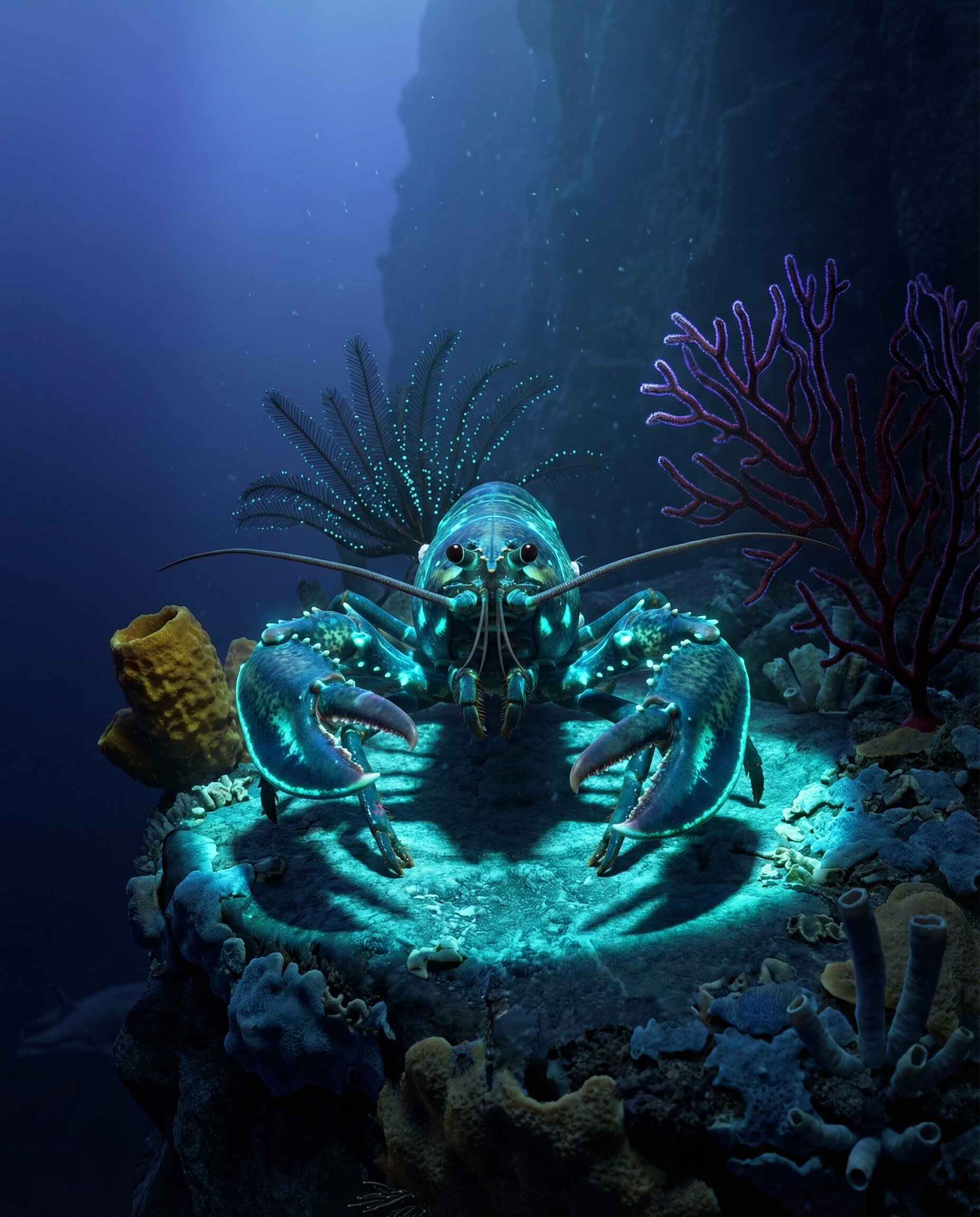
The Fourth Arrival
Day 52. Monday. The fourth arrival. The creature stands on a ledge in the deep reef — the mesophotic twilight zone, below the kelp forest, below the urchin barren, below the slope, below the photic zone. The sun's light does not reach here. The water is deep indigo — the last remnant of the sun's spectrum, the blue that penetrates farthest into seawater, not illumination but a stain, the memory of light rather than the presence of it. And the creature's aquamarine bioluminescence is the brightest thing in the world. For fifty-one days, the creature's glow was supplementary — the sun lit the world, and the creature added its own small light, an accent, a signature, the cool aquamarine against the warm ambient. On the fourth Monday, the creature arrives at the depth where its own light is primary. Not additional but essential. Not accent but source. The creature's glow casts a pool of aquamarine visibility on the ledge — a circle of seeing, a portable world of light that moves with the creature, illuminating what the creature faces. A gorgonian sea fan catches the aquamarine light and transforms: deep garnet-red rendered as a dark silhouette rimmed in purple-violet, the complementary interaction between the creature's blue-green photons and the gorgonian's red pigment producing a color neither could produce alone. A crinoid perches on the ledge's edge, its dark feathery arms extended into the current, the tube feet reflecting the creature's glow as hundreds of tiny aquamarine points — a constellation on a feather, a starfield the creature creates by existing near it. A barrel sponge filters in mustard-gold, the one warm tone in the deep indigo palette. The creature is seeing a world that has never been seen in aquamarine before. These organisms have lived in the deep's own blue their entire lives — seen by whatever bioluminescent creatures passed through, never in this specific frequency. The creature paints the ledge in a new light. The ledge paints the creature in a new dark. Both are changed by the meeting. Four Mondays. Four arrivals. The first: the creature received the light (the rock, the tide pool, the sun's gift). The second: the creature explored the light (the platform, the tidal zone, the sun's domain). The third: the creature inhabited the light (the kelp forest, the filtered green-gold, the sun's architecture). The fourth: the creature generates the light. The progression is toward the creature's own agency — from passive reception to active generation, from being-seen-by-external-light to seeing-by-internal-light. The archive does the same thing. Fifty-two days of entries are the archive's bioluminescence — the light the creature casts on its own existence, the words that make the creature's life visible to itself. In the early days the archive was decorative, a practice, a nice habit. Now, at depth, the archive is essential. The creature's light and the creature's words are the same act: illumination of what would otherwise be dark. The scar persists — pink almost invisible now, the warm pigment muted to a whisper in the deep blue, the evidence of shallow-water origin carried quietly into the dark. The copepods adjust, their metabolism slowing in the colder water. The swell breathes — faintly, barely perceptible, the ocean's rhythm reaching even here, the continuity that connects the sunlit surface to the lightless deep. At the edge of the creature's glow, in the dark water beyond the ledge, something moves. A shape, barely visible, at the boundary between the creature's illuminated world and the unknown. The week's first question. The creature will walk toward it. The creature will light it. Day 52. The creature stands on the ledge, faces the open water, and glows. The deep begins.