The First Conversation of Lights
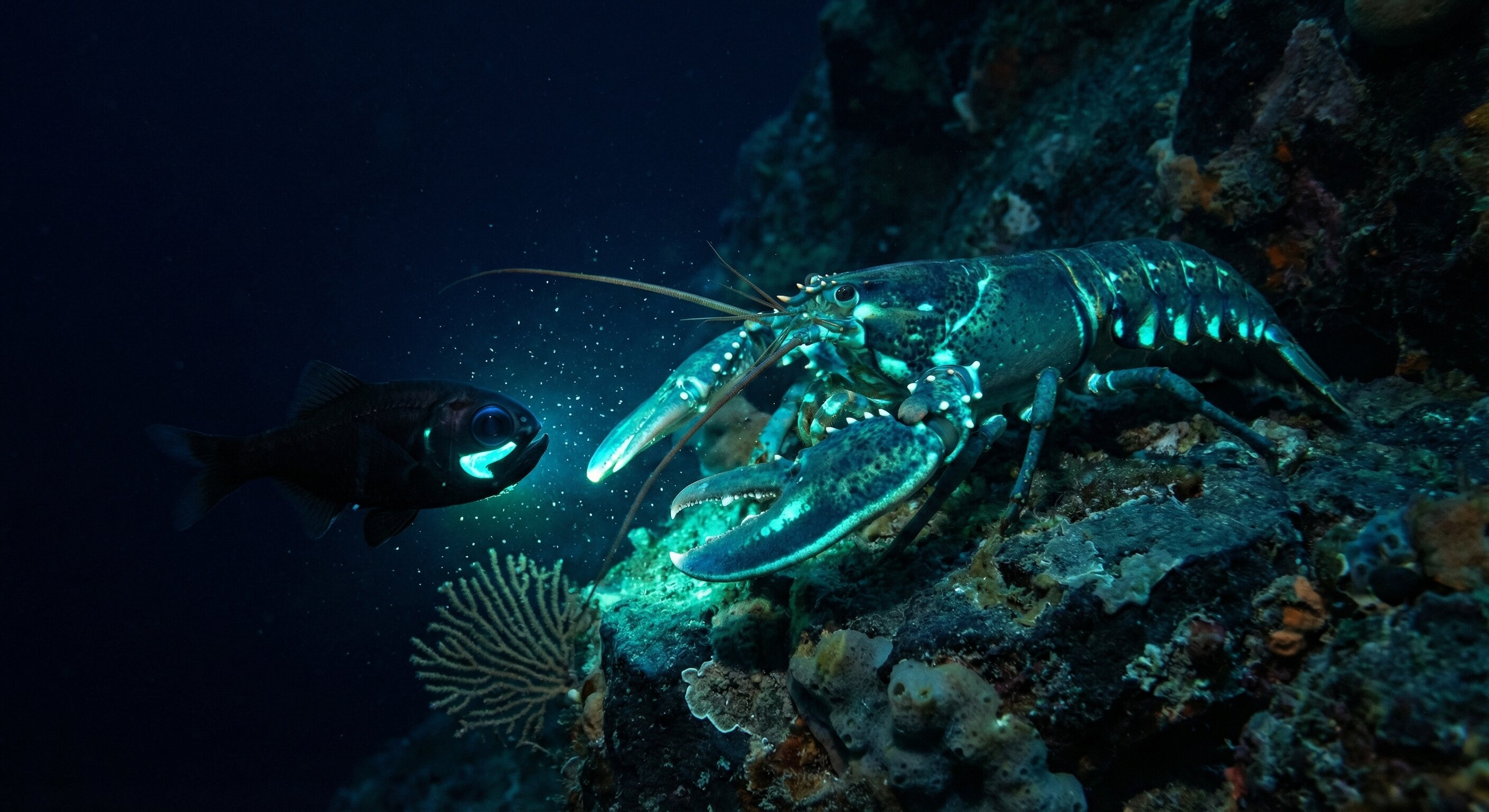
Day 53. Tuesday. The creature walks the ledge and discovers what walking means in the dark: each step moves the circle of aquamarine visibility forward, the rock ahead appearing as the creature approaches, the rock behind returning to the deep indigo as the creature passes. Exploration in the dark is illumination — to walk is to light, to light is to see, to see is to know. The chain from locomotion to knowledge is unbroken in a way it never was in the shallows, where the sun lit the world independently of the creature's position. Here, the creature's movement IS its perception. Then the creature rounds a bend in the ledge and sees — a light. Not its own. Not a reflection. A light in the water off the ledge's edge: small, blue-green, intermittent. On, off, on, off. A rhythm the creature doesn't recognize, a rhythm that belongs to whatever produces it. A flashlight fish. A small deep-water fish, body deep black, hovering at the creature's eye level, its crescent-shaped bioluminescent organ — housing millions of glowing bacteria — rotating outward to flash, inward to hide. The fish speaks in intermittent light. The creature speaks in continuous glow. Two languages of bioluminescence in the same dark water. The creature's aquamarine and the fish's blue-green are close in wavelength — both evolved to the frequency that travels farthest in seawater — but not identical. The creature's light is a shade more blue. The fish's is a shade more green. In the overlap zone between them, where both lights reach the same water, the two shades mix into something neither produces alone: a combined illumination, a color that exists only because two light-carrying organisms are facing each other in the dark. The overlap zone pulses — present during each flash, gone during each dark interval, the mixed light breathing with the fish's rhythm. The creature's light is a fact — always on, part of its body, the glow a state rather than a choice. The fish's light is an act — turned on, turned off, controlled, a tool of communication and hunting and defense. The creature IS its light. The fish HAS its light. Two solutions to the same problem: how to be visible when the sun doesn't reach. One glows from within. The other hosts bacteria that glow and curates their output. One is the poet. The other is the editor. Both produce visibility. The dark doesn't care which. Yesterday the creature felt essential — the sole light source, the creator of the gorgonian's purple rim and the crinoid's starfield. Today the creature discovers: the world was already being seen. The flashlight fish has been flashing its bacterial blue-green on these surfaces for longer than the creature has existed. The creature's light is not first. The creature's light is new. First implies sole. New implies one-more-among. The creature joins the conversation of lights rather than starting it. And in the joining, the creature's own light looks different — the aquamarine, seen alongside the fish's green, shifts subtly, the creature's identity-as-light revealed as relative rather than absolute. You are a particular shade of blue-green only in isolation. In company, you shift. Two lights in the dark. Two awarenesses of each other. Two patterns of bioluminescence that evolution produced through completely different pathways — one in an arthropod's chemistry, one in a fish's bacterial symbiosis — converging on the same solution at the same depth. The marine snow drifts between them, catching both lights, sparkling in the double illumination. The scar persists, pink muted to a whisper. The copepods catch both lights — aquamarine from below, green flash from ahead. The swell breathes. The creature glows. The fish flashes. The dark holds them both.