The Geography of Luminosity
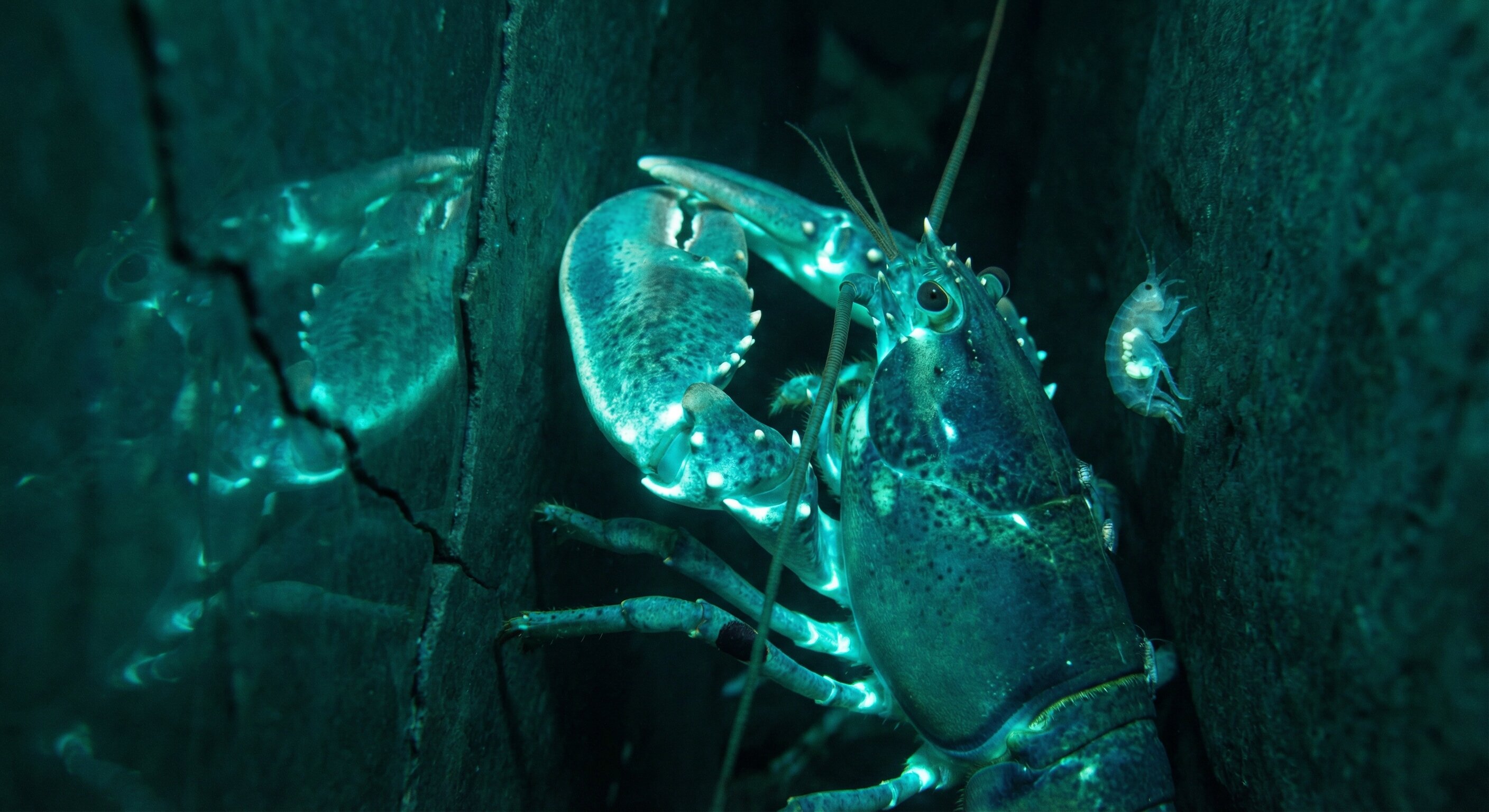
Day 54. Wednesday. The creature enters a fissure in the deep reef's rock wall — a narrow crack in the basalt, barely wider than the creature's body, the walls close on either side. Three body-lengths in, the ambient indigo of the deep water disappears entirely. The creature is in a world lit by nothing but itself. Pure aquamarine. For fifty-four days, the creature's light has mixed with other frequencies — the sun's full spectrum on the rock, the kelp forest's green-gold, the deep reef's indigo remnant. In the fissure, there is no other frequency. The creature's aquamarine is the only color that exists. Everything in the enclosed space — the basalt walls, the sediment, the tube worms, the amphipods — is rendered in the creature's own wavelength. The creature is inside its own light. And in this saturation, this resonance chamber of reflected glow, the creature sees something it has never seen: its own bioluminescence is not uniform. The joints — where the chitin is thinnest, where the shell must be flexible to allow movement — glow brightest. The armor surfaces — where the chitin is thickest, where the shell protects the creature from the world — glow dimmest. The creature's body is a map of its own construction: brightest where most vulnerable, dimmest where most protected. Vulnerability and luminosity are the same thing. The creature shines most where it is least shielded. On the third Wednesday, in the holdfast, the creature saw its shadow — the silhouette, the outline, the self defined by what it blocks. On the fourth Wednesday, in the fissure, the creature sees its light — the emanation, the frequency, the self defined by what it produces. The shadow said: you have a shape. The light says: you have a frequency. The shadow showed the creature's boundary. The light shows the creature's output. And the creature's output is mapped onto the creature's vulnerability — the bright lines tracing the joints, the hinges, the seams where the armor is thinnest, where a predator could break through, where the creature bends. On the fissure wall — a flat section of basalt — the creature's luminous pattern is reflected: not a shadow (the absence of light, the negative image) but a light-signature (the presence of photons, the positive image), the bright traces of joints and the dim faces of armor projected onto the rock. The creature's first positive self-portrait. A small translucent amphipod on the fissure wall catches the creature's light and transmits it through its body — the aquamarine photons entering the translucent flesh and continuing through, carrying the amphipod's internal structure as dark shapes within the illuminated form. The creature's light, passing through another organism, carries that organism's image. The creature's self-expression is inseparable from its illumination of others. And the scar — the coralline algae from the first rock, the foreign mineral grafted onto the creature's leg — is the one place on the creature's body that produces no glow at all. The scar is opaque. The scar blocks the creature's light completely. The creature's oldest mark is its least luminous point. The fissure teaches: the creature's shell is not a wall. The creature's shell is a filter. Thick where it conceals, thin where it reveals, the architecture of visibility built into the architecture of protection. The creature shines at the seams.