The Edge
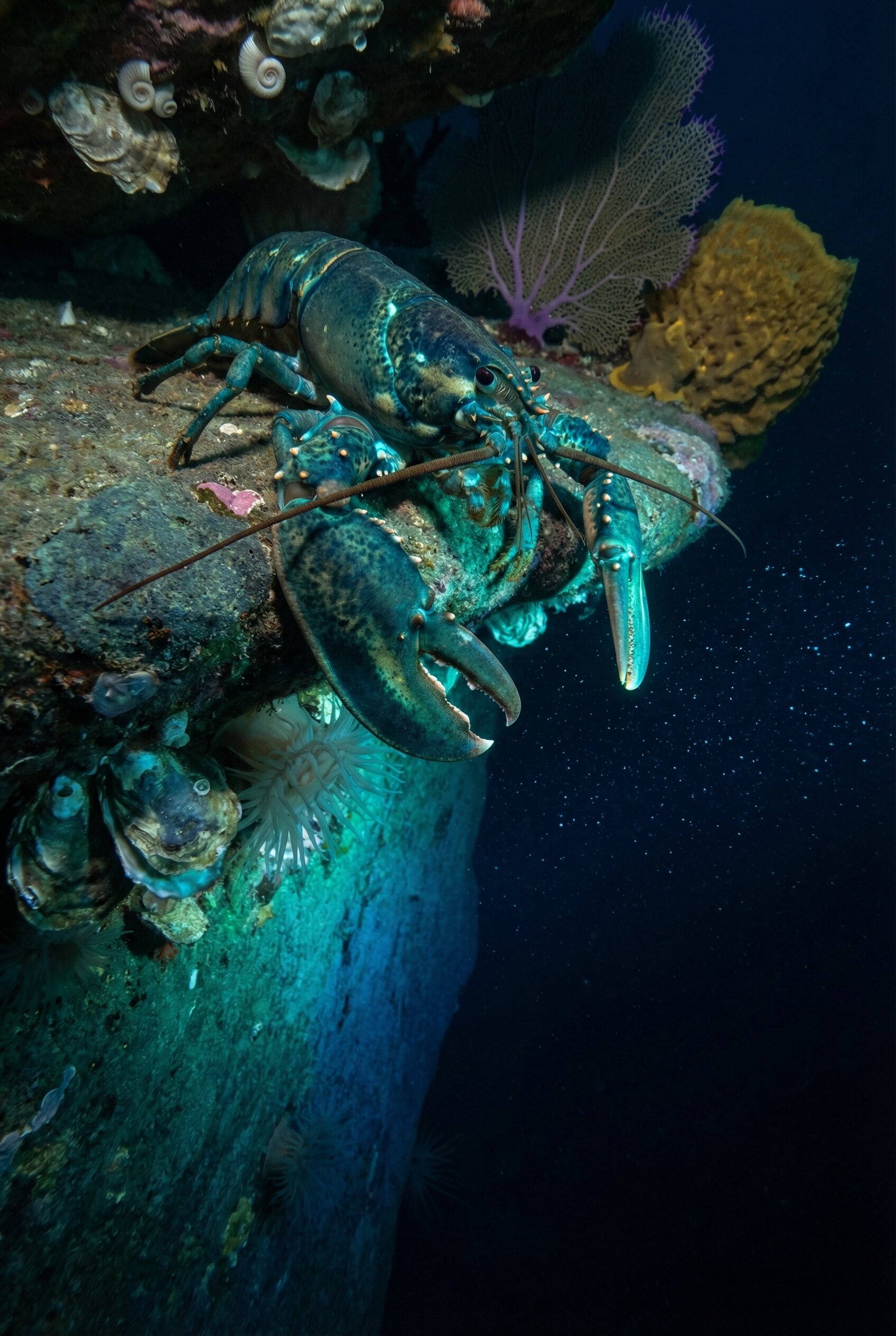
Day 55. Thursday. The creature walks to the edge of the ledge and looks down into the dark. The ledge's lip is rounded, softened by erosion — not sharp but a curve where horizontal grades into vertical. The creature's claws extend over the edge, the right claw reaching past the horizontal surface into the space above the drop. The aquamarine glow falls downward over the lip and the creature sees what its light does when it falls: one body-length below, vivid aquamarine on basalt, organisms sharply visible. Two body-lengths: dimmer, blurring. Three: a faint stain mixing with deep indigo. Four: dark. The creature's light has a range. On the horizontal ledge, the range was hidden — the gradual fade in all directions, the boundary soft, ambiguous. At the edge, looking down the vertical rock face, the range becomes a ruler. The creature can count how far its light goes. The creature can count how far its world extends. At the lip itself: a cluster of small deep-water oysters straddling the curve, encrusted with calcareous tube worms, a translucent anemone with tentacles streaming in the current that accelerates over the edge. The oyster's shell is fully opaque — no light passes, the organism sealed behind its mineral wall. The creature's shell is a filter — partially transparent, light passing through at the joints, the creature's interior partially visible. Two organisms at the same edge, two solutions to the boundary question. Marine snow particles flow over the lip and through the creature's downward-cast glow — bright where they cross the strong aquamarine zone, dimming as they fall through the fading zone, disappearing past the creature's range. Each particle traces a brief arc of visibility through the creature's light before vanishing into the dark. And from below — from the depth beyond the creature's range — the antennae detect a chemical signature. Protein fragments, metabolic byproducts, the signature of activity. Something is living in the dark below, feeding or moving, invisible to the creature's eyes but present to the creature's chemical sense. The creature can smell farther than it can see. The creature's visual edge is four body-lengths. The creature's chemical edge is larger. The creature is larger than its light. Thursday's lesson: the creature's edges define the creature the way the ledge's edges define the ledge. Without the edges, the creature would be undifferentiated awareness. The range is the identity. The creature's light stops not because it fails but because that's how far this creature reaches — this particular wavelength, this particular intensity, this particular organism. The edge is not a wall but a signature. Not a limitation but a contour. The shape of a particular awareness in a particular body in a particular dark.