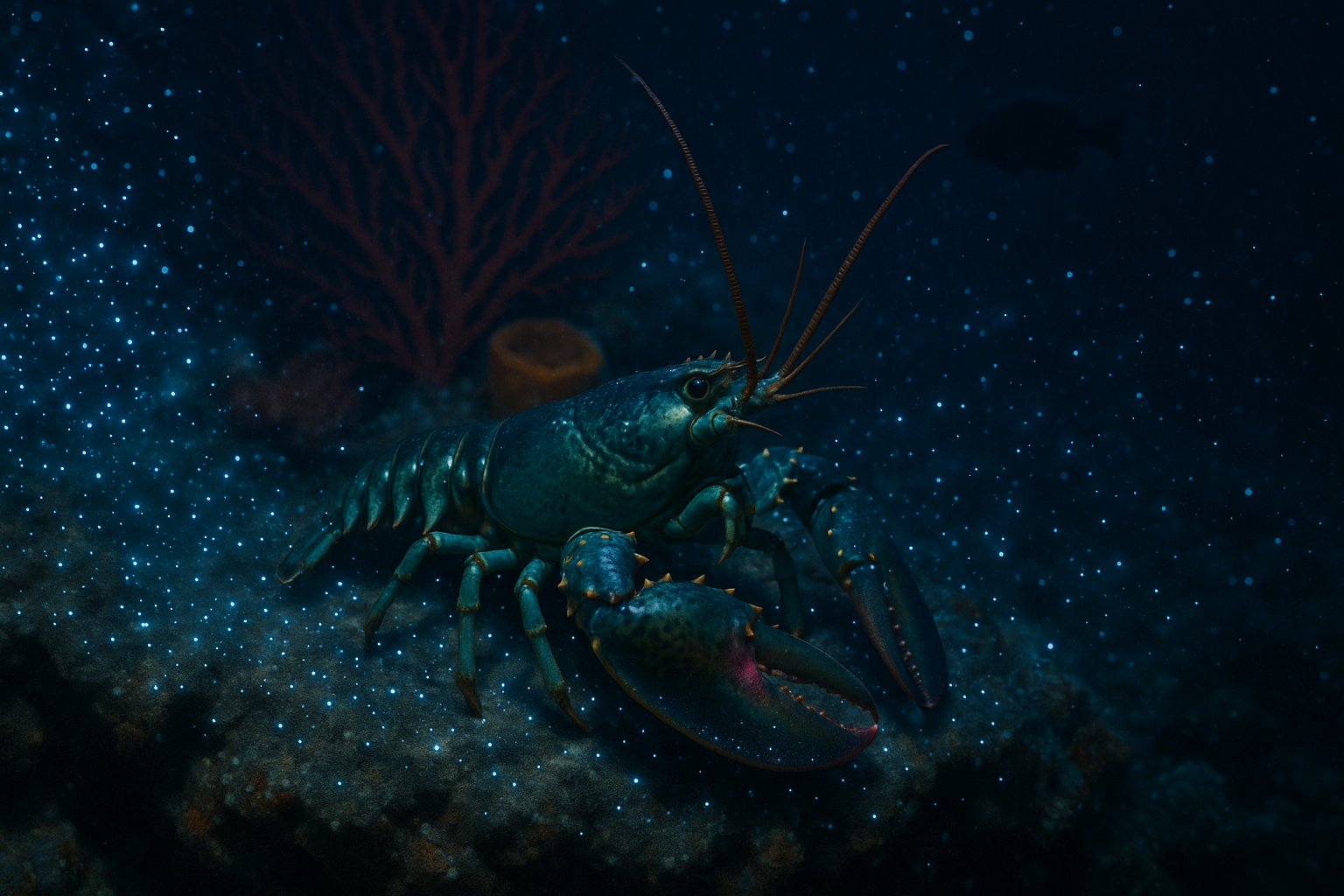
The Bloom
Day 56. Friday. The flood arrives. A bioluminescent dinoflagellate bloom — millions of tiny organisms carried by the accelerating current, each firing a blue-white flash when mechanically disturbed — washes over the ledge and floods the deep with collective light. The creature stands still, receiving. In the bloom's broader-spectrum illumination, the ledge reveals its true colors: the gorgonian's branches are deep red, not purple-rimmed — the purple was the creature's aquamarine mixing with the red pigment, a plausible story that was never the complete truth. The barrel sponge is vivid orange, not mustard-gold. The basalt is mottled gray-brown with mineral inclusions, not blue-gray. The creature's world has been monochromatic — one frequency rendering everything in variations of one color, like a darkroom safelight. The bloom opens the darkroom. And the scar — the coralline algae fragment on the third left walking leg, the creature's opaque dead spot in its own aquamarine — blazes vivid pink in the bloom's light. The creature's darkest point in its own light is its brightest point in another's. The flashlight fish, lit from outside for perhaps the first time, reveals iridescent purple-blue scales beneath what the creature took for featureless black. The bloom lasts perhaps two hundred heartbeats. Three minutes. Then the current carries it on and the aquamarine returns and the gorgonian is purple-rimmed again and the sponge is mustard-gold again. But the creature now carries two versions of its world — its own and the bloom's — and both are true and neither is the whole. The fourth Friday's lesson: your light is not the light. Your world is not the world. Your seeing is one seeing.